The Geometry Doesn't Lie: Why a Mild Custom Will Out-Ride a Show Pony Every Time
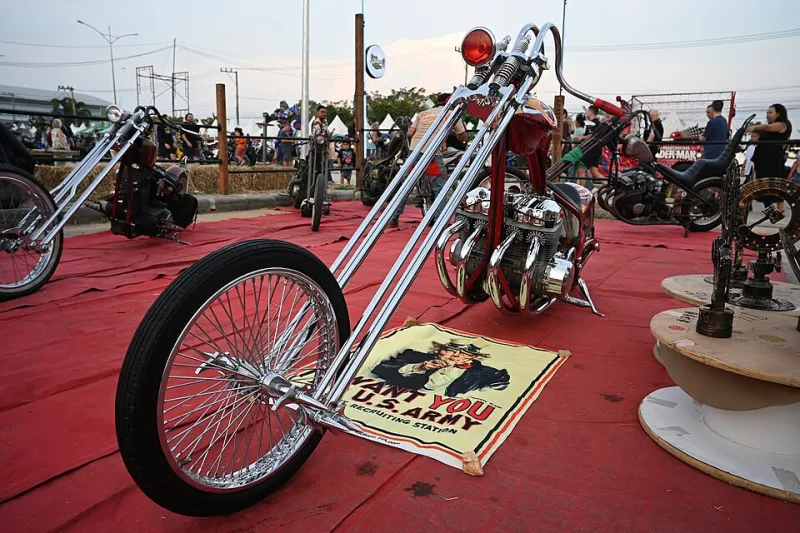
Photo: PattayaPatrol, CC BY-SA 4.0, via Wikimedia Commons
Every summer there's a chop in a show field that stops people dead. Forty-five degrees of rake, forks like goalposts, a front wheel off a fairground ride. It's a beautiful object. It is also, in any honest sense, not a motorcycle — it's a motorcycle-shaped sculpture that happens to have an engine.
I've got no problem with sculptures. I've got a problem with people buying one thinking they've bought a bike, then discovering the difference halfway round a damp roundabout in Derbyshire.
Two Numbers That Decide Everything
Rake is the angle of the steering head away from vertical. Trail is the distance the front tyre's contact patch sits behind the point where the steering axis hits the road. Between them, they decide whether a bike steers, self-centres, or fights you.
More rake means more trail, which means stronger self-centring and heavier, slower steering. That sounds stable. And it is — up to a point. Push past that point and you get flop: the front end wants to fall into the turn, then over-correct, then fall again. On a straight motorway it feels planted. At 20mph in traffic, or on a slow left turn onto a wet side road, it feels like the bars are deciding things for you.
And that lever effect cuts both ways. Long forks don't just alter the angle — they magnify every load. Braking forces bend them. A pothole tries to twist the whole front end. A frame neck designed for 550mm forks suddenly has to survive 900mm ones with a heavier wheel on the end.
Where It Goes Wrong on Real Roads
British roads aren't a show hall floor. They're cambered, patched, gritted, resurfaced with chippings, and full of ironwork sunk an inch below the surface. A bike with marginal geometry handles that fine on a dry Sunday. It handles it badly in the rain in November.
The three failure modes I've seen most often:
Low-speed flop and wobble. Half a degree of extra rake past the sensible point and every T-junction becomes a negotiation. The bike drifts, you correct, it drifts back. Riders blame themselves. It's geometry.
Fork flex under braking. Skinnier tubes, longer span, more leverage. The front end bends, geometry changes mid-stop, and the brake that felt fine in a straight line becomes vague exactly when you need it most.
Frame stress at the neck. Without proper gusseting and a decent jig, a raked neck is a fatigue crack waiting for a deadline. You do not want to find that out at 60mph.
The MoT Is Not Your Friend Here
Here's a thing worth understanding clearly: the MoT is a minimum standard, not an engineering approval. A tester will check that steering moves freely, that the head bearings aren't shot, that fork legs are secure and that the bars do what they're meant to. A badly-raked chop can sail through an MoT and still be genuinely unpleasant and, in the wrong hands, unsafe.
Passing the test doesn't mean the geometry works. It means nothing was obviously about to fall off on the ramp.
The Insurer Is the Real Referee
This is the bit that quietly ruins people. If your frame has been raked, hardtailed, or altered in any significant way and you haven't declared it, you may as well be riding uninsured. Non-disclosure is a gift to any loss adjuster, and if you've hurt a third party, it's not just your bike on the line.
A radically altered frame can also push you into needing individual approval rather than a simple registration transfer. That's not scaremongering, it's just the paperwork side of building a bike that has changed its own fundamentals. Speak to a builder who deals with this every season — they'll tell you the questions to ask before you spend a penny on chrome.
Numbers That Actually Work
A rideable chop isn't a compromise, it's a target. Somewhere in the region of 34 to 40 degrees of total rake, trail in the 100 to 130mm window, fork length within a few inches of stock, and a front wheel light enough that the steering can recover from a bad line.
That will still look unmistakably custom. It'll still turn heads in a lay-by. The difference is you'll ride it to the coast, not trailer it there.
If you want more stance without butchering a neck, changed triple trees with offset are the grown-up answer. Racers have used altered yokes to tune steering geometry for decades. It's reversible, it's measurable, and it doesn't put a torch near the frame.
Before the Welder Comes Out
Measure twice, then measure again with the bike loaded and on the ground — with you sitting on it, ideally. Make sure the build sits on a proper jig. Gusset the neck as though your life depends on it, because it might. Keep the head bearing axis in mind at every stage. And ask your builder to show you the numbers, not just the sketch. A good fabricator will have numbers.
A bad one will say: it'll be fine, everyone does it.
The Big Wheel Trap
Twenty-one inches up front with a reasonably slim tyre steers fine and looks right. Push to a fat front hoop on a heavily raked neck and you've chosen a wheel that's hard to source tyres for, harder to brake on, and heavier than the geometry wants. Add a narrowed brake choice and you've got a bike that's committed itself to a life of gentle use.
Big front wheels aren't the problem. Big front wheels on the wrong geometry, with no brake development and a rider who hasn't thought about it, are the problem.
The Verdict
A mild custom, engineered with thought and measured on a jig, will out-ride a show pony every single time — not on a spec sheet, but on a wet A-road at seven in the morning. The blokes who build those bikes are the ones still riding them ten years later, and their chops are the ones with stories in the paintwork rather than polish on the stand.
That's the culture worth celebrating. Not who can go longest, but who can go furthest and still want to go again tomorrow.